Viscosity, Filtration, and Clarification Bottlenecks in Biomass-Derived Media Ingredients
Biomass-derived media ingredients can improve fermentation economics, but they rarely behave like clean commodity inputs. Grain fractions, plant protein meals, yeast-derived streams, oilseed residues, and mixed agricultural side streams bring useful nutrients along with physical handling constraints.
For a fermentation ingredient manufacturer, the question is not only whether the substrate contains carbon, nitrogen, minerals, or growth factors. The operational question is whether the hydrolysate can be pumped, heated, separated, standardized, documented, and delivered with consistent performance.
Enzymegen works as an enzyme supplier for fermentation media production where hydrolysis must support both nutrient release and plant operability. Viscosity reduction, filtration behavior, clarification quality, and batch-to-batch media consistency are connected decisions, not isolated troubleshooting items.
Why physical processing becomes the bottleneck
A biomass slurry can look acceptable in a lab beaker and still create production constraints after scale-up. The reasons are usually structural:
- Long starch and dextrin fragments increase body and slow transfer.
- Soluble and insoluble proteins create haze, foam tendency, and difficult solids interfaces.
- Cell wall polysaccharides bind water and raise apparent viscosity.
- Fine suspended solids blind filter media before the expected cycle endpoint.
- Lipid, fiber, and protein complexes interfere with clean clarification.
- Variable raw material lots change flow behavior even when composition appears similar.
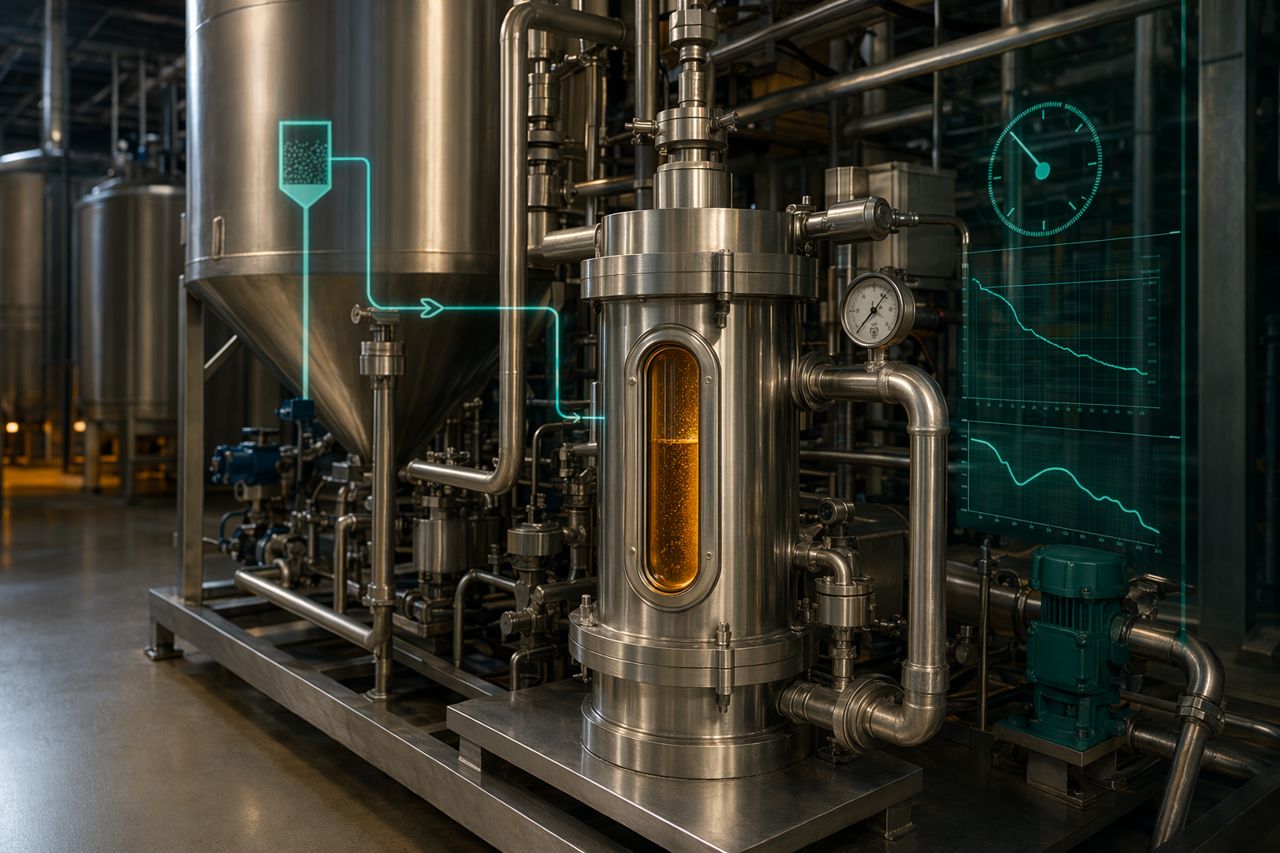
These issues affect the hydrolysate plant before the fermentation customer ever evaluates the ingredient. High viscosity reduces heat transfer and mixing efficiency. Slow filtration restricts daily output. Poor clarification increases downstream polishing burden. Inconsistent soluble profiles create uncertainty in media performance.
Viscosity is a process cost, not just a lab number
Viscosity affects plant economics in practical ways:
- Higher pump load and longer transfer times
- Slower tank turnover
- Uneven thermal treatment
- Less predictable solids suspension
- Increased risk of localized overprocessing or underprocessing
- More difficult concentration or evaporation, where used
In biomass-derived media ingredient production, viscosity is often driven by a mixed matrix rather than a single component. Starch fragments, beta-glucans, arabinoxylans, pectic materials, proteins, and fine particles can all contribute. Treating only one fraction may improve a reading without improving plant throughput.
The better target is a controlled molecular profile: enough hydrolysis to improve handling and nutrient availability, without pushing the material into excessive soluble fines, bitter peptides, excess reducing sugars, or separation instability.
Filtration problems usually start upstream
Filter performance is frequently discussed at the filter, but the root cause often forms in the hydrolysis tank.
Common upstream contributors include:
- Partially opened cell wall structures that release fine solids but do not fully separate
- Protein fragments that bind with fiber and form compressible cakes
- Starch-rich residues that swell under heat
- Incomplete liquefaction that leaves deformable particles
- Overly aggressive treatment that creates colloidal material difficult to capture
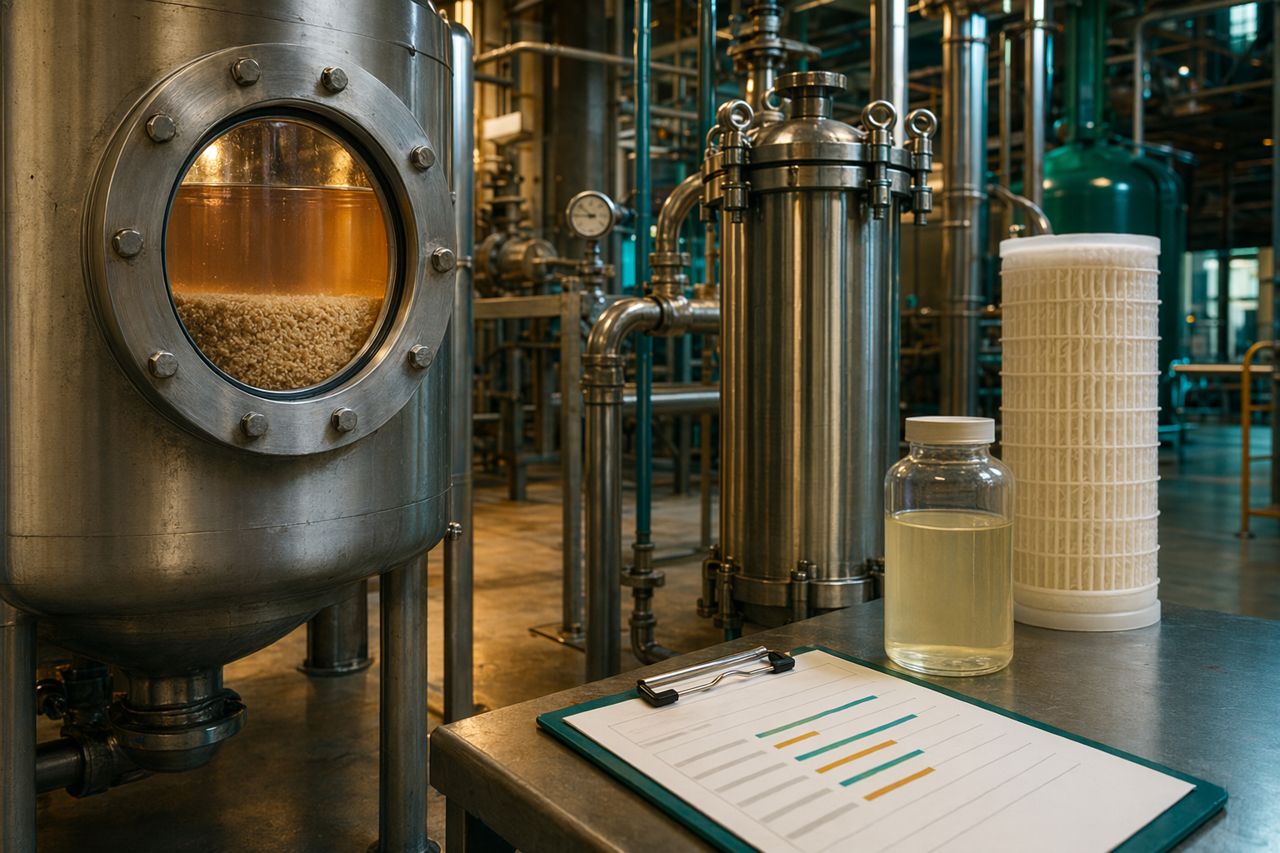
A filter can only manage the particle and soluble profile it receives. Enzyme selection, addition sequence, solids loading, hold time, pH window, and temperature window all influence whether the stream forms a porous cake or a blinding layer.
For production teams, the useful measure is not enzyme intensity in isolation. The useful measure is whether filtration cycles become longer, filtrate quality becomes more consistent, and operators can maintain throughput without constant intervention.
Clarification depends on the interface
Clarification is not simply the absence of visible solids. A hydrolysate may look dark, amber, or opaque and still separate cleanly if the solids interface is firm and predictable. Conversely, a lighter-looking stream can create soft flocs and rag layers that are difficult to cut.
In biomass-derived media ingredients, clarification performance is shaped by:
- Particle size distribution after hydrolysis
- Soluble protein and peptide profile
- Residual gums and cell wall fragments
- Lipid-protein interactions
- Heat history
- Ionic conditions and pH
- Time between hydrolysis and separation
Enzymes can support clarification when selected for the actual constraint. Protease, amylase, cellulase, hemicellulase, beta-glucanase, pectinase, and related enzyme systems each affect different structures. The right program depends on the substrate and the separation equipment, not on a generic recipe.
The risk of maximum hydrolysis
More breakdown is not always better. Fermentation media ingredients need controlled nutrient release, not uncontrolled digestion.
Overprocessing can create new problems:
- Excess soluble fines that pass through filters and add haze
- Peptide distributions that do not match the target organism
- Higher osmotic load than intended
- Increased browning tendency during heat treatment
- More variable feed behavior in customer fermentation
- Loss of useful functional properties in complex media blends
The commercial objective is a stable operating window: reliable viscosity reduction, improved separation, and a nutrient profile that supports predictable fermentation performance.
Matching enzyme systems to substrate fit
Enzymegen evaluates enzyme fit around the substrate and the manufacturing objective. For biomass-derived media ingredients, that usually means reviewing:
Substrate composition
The same enzyme approach will not behave identically across corn steep-derived streams, soy fractions, wheat co-products, yeast-derived biomass, oilseed meals, pulse proteins, or mixed agricultural residues. The dominant viscosity driver and the target nutrient profile must be identified before selecting the enzyme system.
Process conditions
Enzyme performance must match the plant, not the other way around. Practical selection considers:
- Slurry solids level
- Available pH window
- Temperature profile
- Hold time
- Agitation and heat transfer limits
- Order of addition
- Compatibility with kill step or downstream thermal treatment
- Separation equipment and target filtrate quality
Downstream outcome
A media ingredient plant may need lower viscosity for transfer, better clarification before concentration, improved soluble nitrogen consistency, or a cleaner fermenter response from the final customer. Each outcome can require a different hydrolysis strategy.
Scale-up: what changes from pilot to plant
Pilot work is useful only when it predicts plant behavior. Physical bottlenecks often become more visible at scale because mixing, heat transfer, and residence time distribution change.
During scale-up, production teams should watch for:
- Slower enzyme dispersion in high-solids slurries
- Temperature gradients that create uneven hydrolysis
- Hold-time variation across large tanks
- Shifts in particle behavior under full-scale pumping
- Filter cake compression that was not seen in small trials
- Clarifier interface instability under production feed rates
Enzymegen supports enzyme selection with scale-up practicality in mind. The goal is not a perfect benchtop hydrolysate. The goal is a repeatable process that operations, quality, and commercial teams can defend.
Documentation matters for B2B fermentation ingredients
Fermentation ingredient customers expect consistency. Documentation helps connect enzyme-assisted processing to procurement, quality, and technical service requirements.
Relevant documentation may include:
- Product specification alignment
- Ingredient and processing aid statements where applicable
- Allergen and source information where applicable
- Lot traceability expectations
- Recommended handling and storage conditions
- Process guidance for integration into hydrolysate production
- Change-control communication for commercial supply
For ingredient manufacturers, documentation reduces friction during customer qualification and supports long-term supply agreements.
Practical indicators that enzyme optimization is needed
A hydrolysate plant should review its enzyme strategy when it sees any of the following:
- Viscosity drift between raw material lots
- Filter cycle times limiting daily output
- Frequent filter media changes or premature blinding
- Clarifier interface instability
- High recycle or rework volume
- Inconsistent soluble nutrient profile
- Fermentation customer feedback tied to media variability
- Difficulty scaling a promising pilot hydrolysate
These are not only production issues. They affect cost of goods, delivery reliability, technical credibility, and customer retention.
How Enzymegen supports fermentation media ingredient manufacturers
Enzymegen supplies enzyme systems for manufacturers producing fermentation media ingredients from biomass-derived streams. Our support is focused on controlled hydrolysis and measurable process outcomes.
We help teams evaluate:
- Which substrate fractions are driving viscosity and separation limits
- Which enzyme classes are relevant to the feedstock
- How to sequence treatment for starch, protein, fiber, or mixed matrices
- How to avoid overprocessing
- How to define pilot trials that reflect plant constraints
- How to connect hydrolysate quality to customer fermentation performance
- What documentation is needed for commercial qualification
The result should be a media ingredient that is easier to manufacture, easier to standardize, and more reliable in fermentation use.
One-minute process explainer
This page includes a faceless explainer video showing how controlled enzyme treatment can shift a biomass-derived stream from high-viscosity slurry to a more consistent hydrolysate with improved separation behavior and clearer process targets.
Request a quote
If viscosity, filtration, or clarification is limiting your biomass-derived media ingredient process, contact Enzymegen with your substrate type, process conditions, separation equipment, and target outcome.
Enzymegen will review the application and recommend an enzyme supply approach aligned with your production process and commercial media performance goals.